What you need
- An iPhone or iPad with iOS or iPadOS 17 or later, and the free TestFlight app from the App Store.
- An Astria VPN account (email and password), or an Apple ID for the free 24-hour trial on one device.
- Access to the iOS beta. It is free for current Astria VPN users, is not part of any plan and is issued by our support on request.
Step 1: Get the beta through TestFlight
The iOS app is distributed as a beta through Apple’s TestFlight. It is free for people who already use Astria VPN, helps us collect feedback, and is not included in any plan: buying a subscription does not include the iOS app or its support.
To get access, ask our support for an invitation: use “Request access” on the download page (it opens our support chat) or write to support@astriavpn.com. You will receive a TestFlight invitation link. Install the TestFlight app from the App Store, open the link on your iPhone, tap “Accept” and then “Install”. Astria VPN appears on your Home Screen like any other app.
The beta may be updated through TestFlight; install updates there to get the latest version.
Step 2: Open the app and sign in
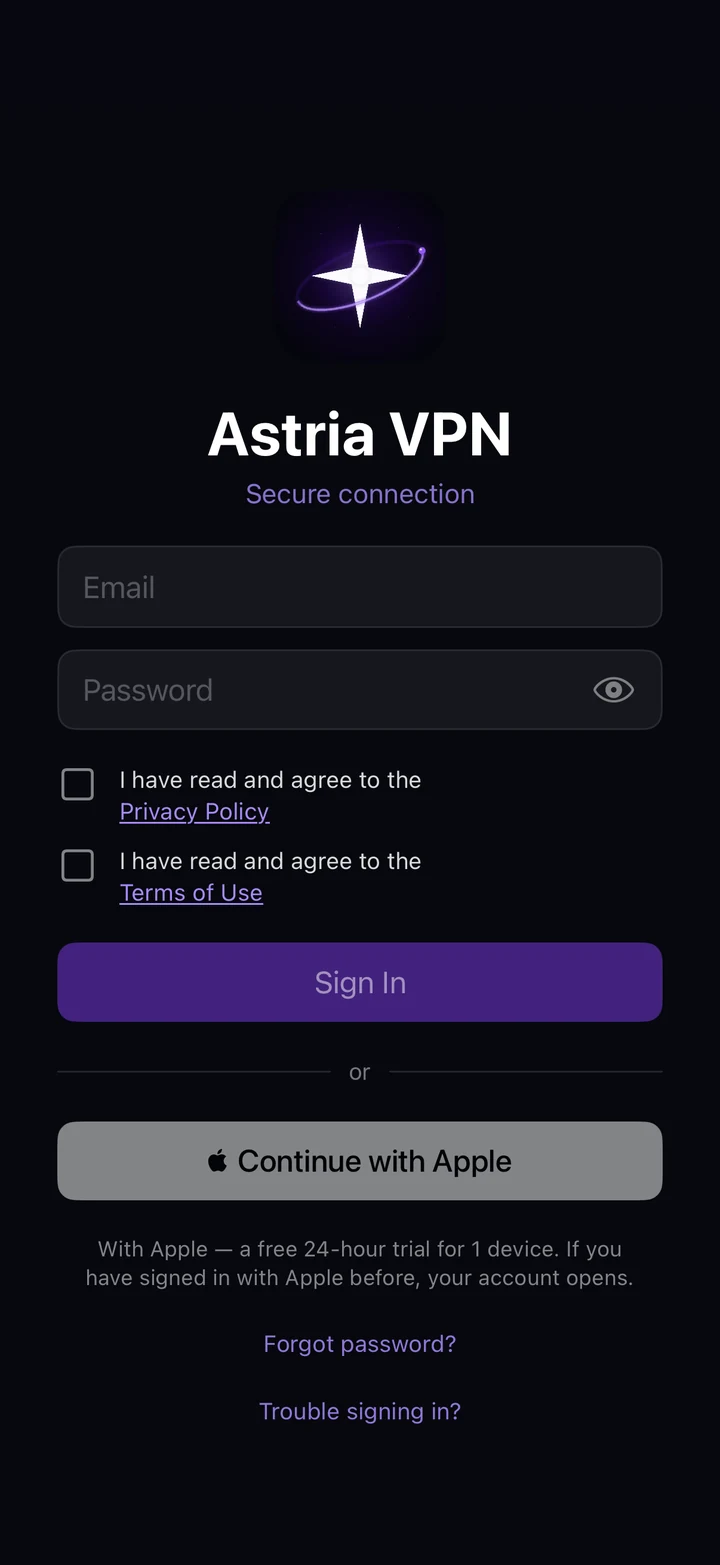
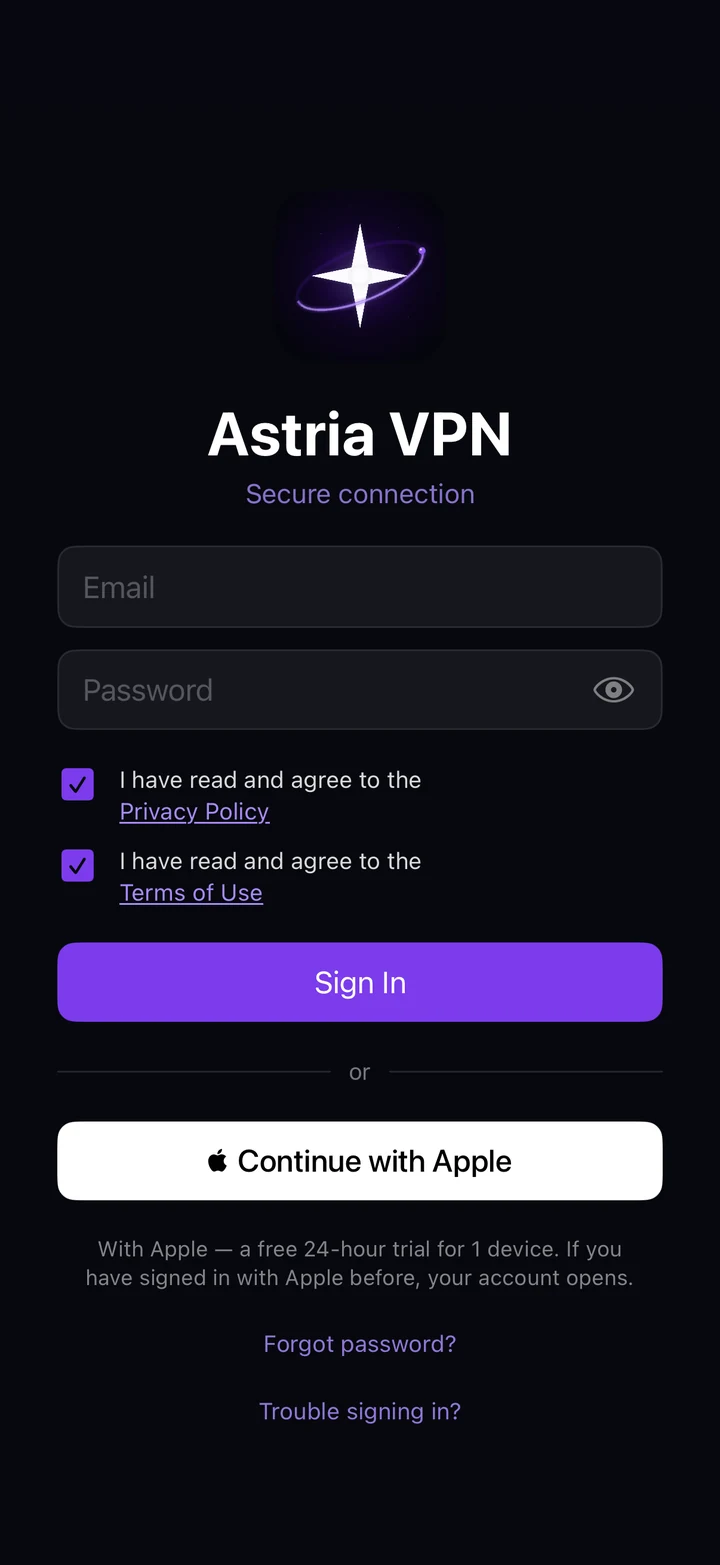
Open Astria VPN. On the sign-in screen enter the email and password of your account, tick both checkboxes to confirm that you have read the Privacy Policy and the Terms of Use, and tap “Sign in”. The button becomes active only after both boxes are ticked.
No account yet? Tap “Continue with Apple”: the free trial through Apple lasts 24 hours on one device, and if you have already signed in with Apple, your account opens. Forgot your password? Tap “Forgot password?” under the buttons — it opens the password recovery page in your browser: enter your email and follow the link we send you. This link appears in beta build 13 and newer (Settings → About shows the build number); on an older build, open billing.astriavpn.com yourself and choose “Forgot password?”. If you cannot sign in, tap “Trouble signing in?” — it opens an email to support@astriavpn.com with a ready subject.
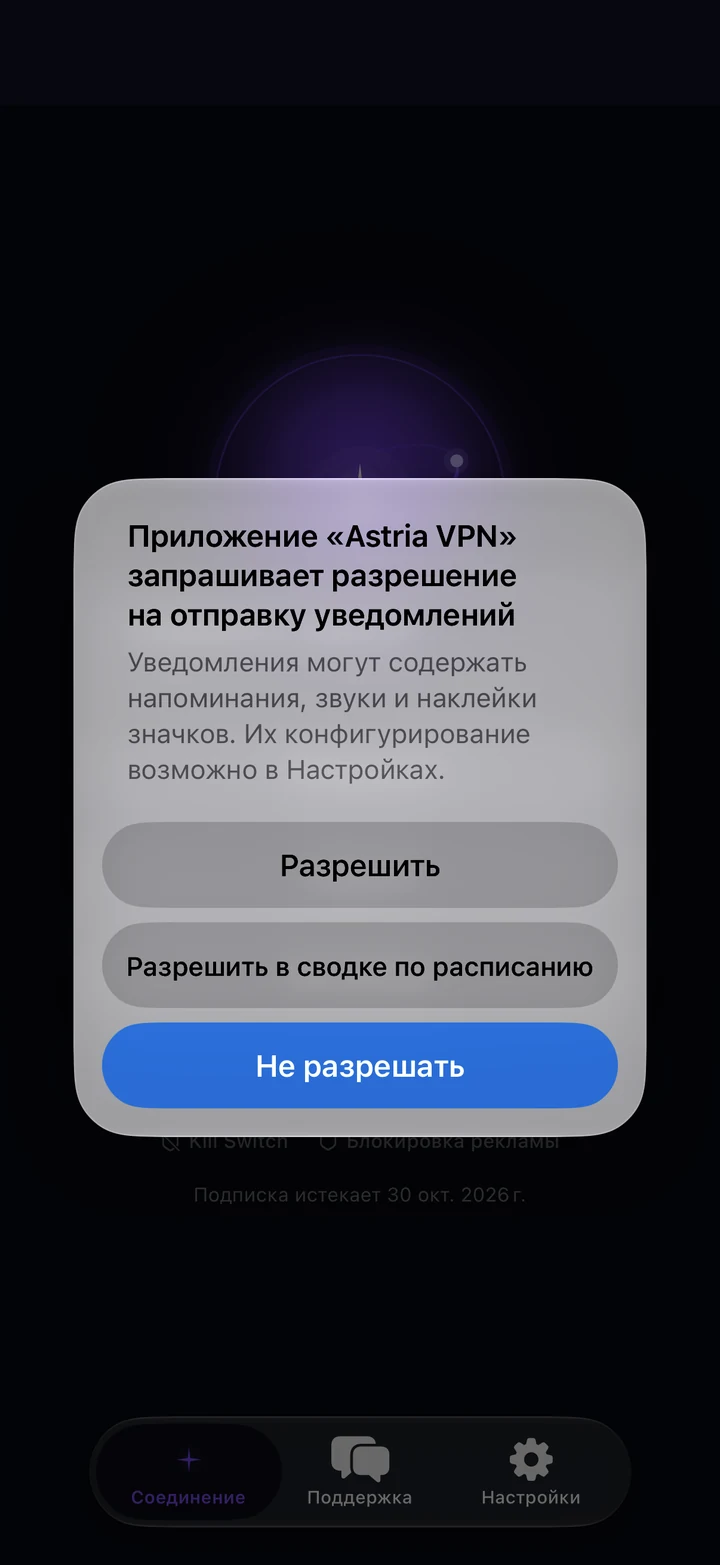
After signing in iOS asks whether Astria VPN may send notifications. They are optional: allow them if you want to see connection and support-chat alerts. The next time you connect, iOS may also show its standard request to add a VPN configuration — tap Allow and confirm with Face ID or your passcode; this is a system window and the app never sees your passcode.
Step 3: Connect with one tap
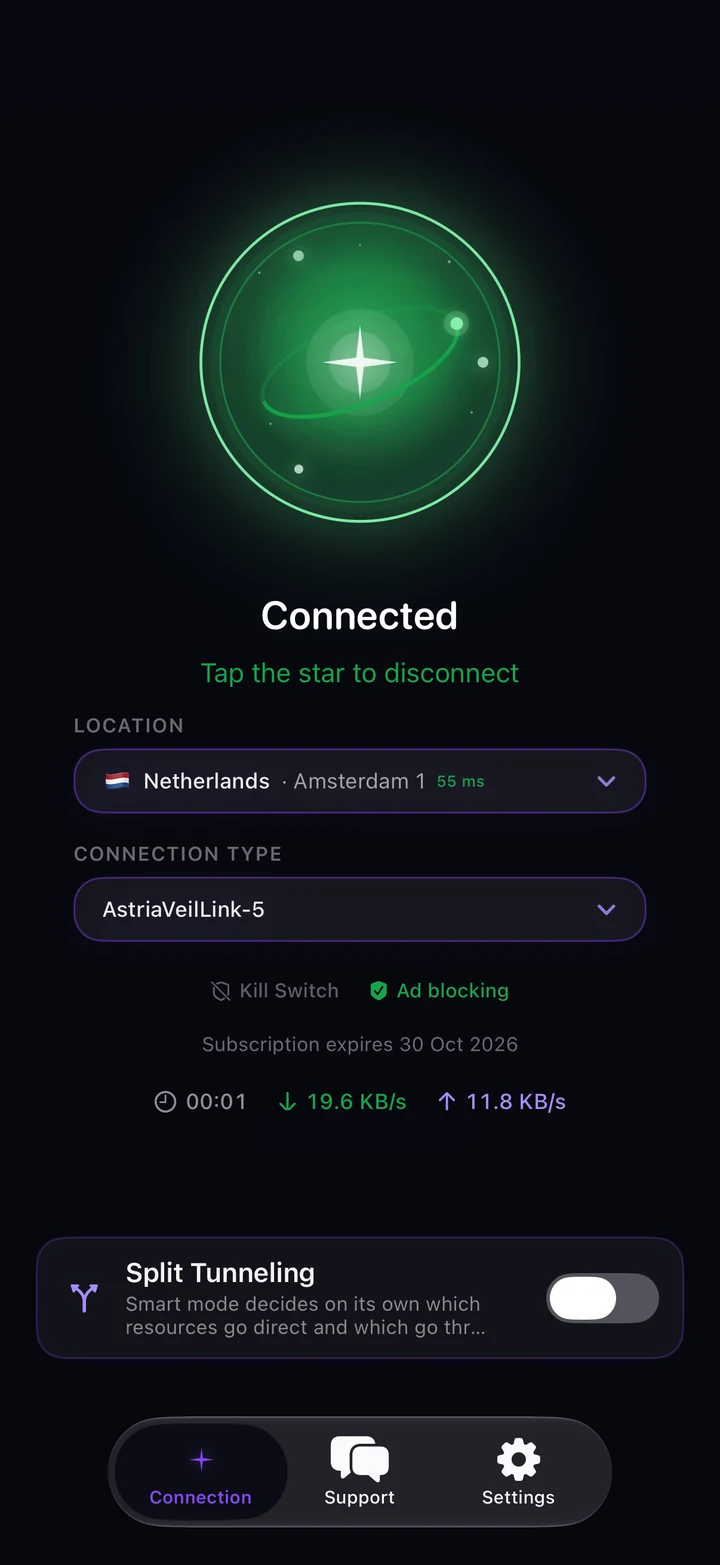
The main screen is the Connection tab. The status reads “Not connected” with the hint “Tap the star to connect”. Choose a location (next step), then tap the Astria star in the middle of the screen.
In a few seconds the status becomes “Connected” and the star turns green. You see a timer, the live download and upload speed and your address inside the tunnel; “Kill Switch” and “Ad blocking” are marked when active. Tap the star again to disconnect. The subscription end date is shown under the location fields.
The small address under the timer (your address inside the tunnel) can be hidden with “Show connection speed” in Settings.
Step 4: Choose a location
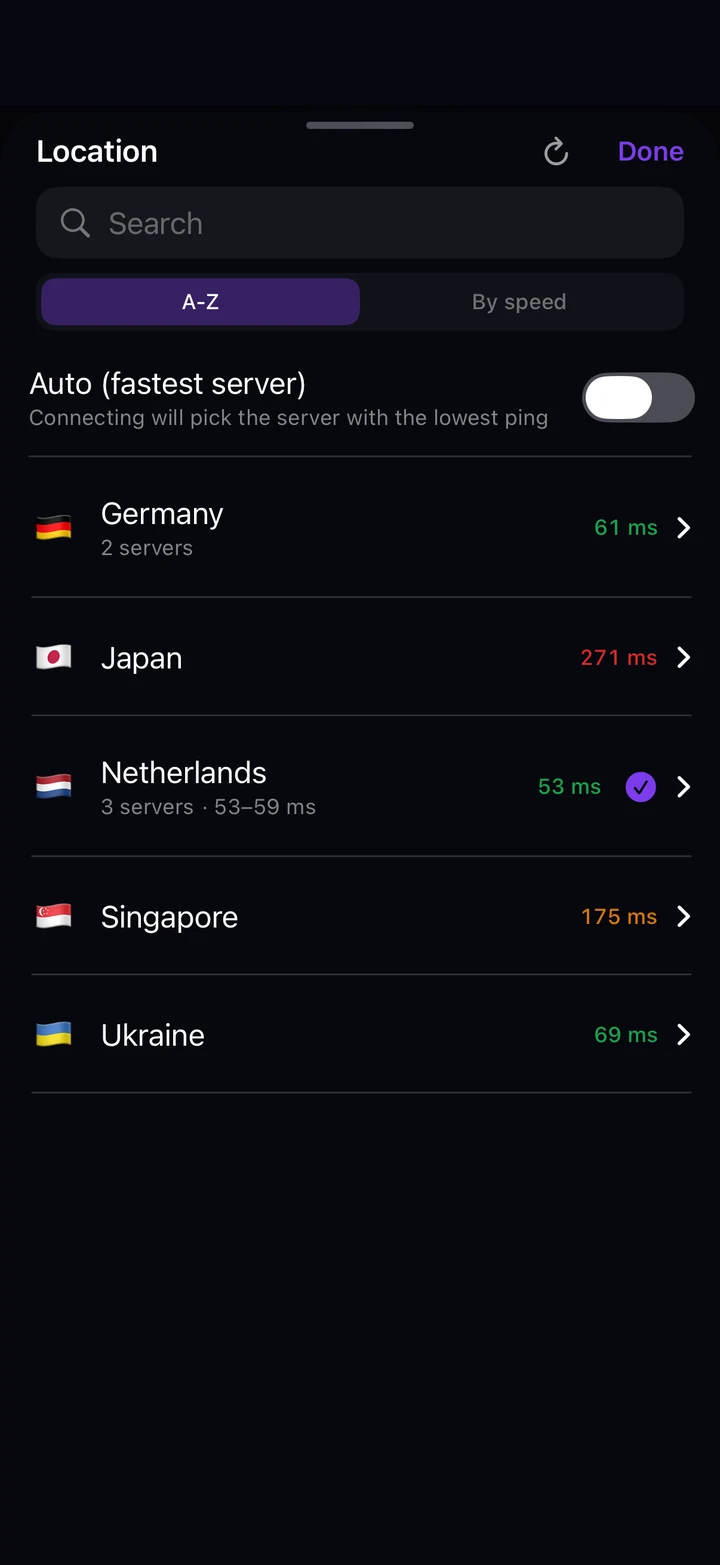
Tap the Location field to open the list of countries. Each country shows its number of servers and its current response time — green means fast. Use “A-Z” to sort by name or “By speed” to put the quickest countries first, type in the search box to find a country, and tap the refresh button to re-measure.
Turn on “Auto (fastest server)” and the app picks the server with the lowest ping each time you connect. Tap a country to choose it or to see its servers, then tap “Done”. The new choice applies the next time you connect.
Step 5: Choose the connection type — start with AstriaVeilLink-5
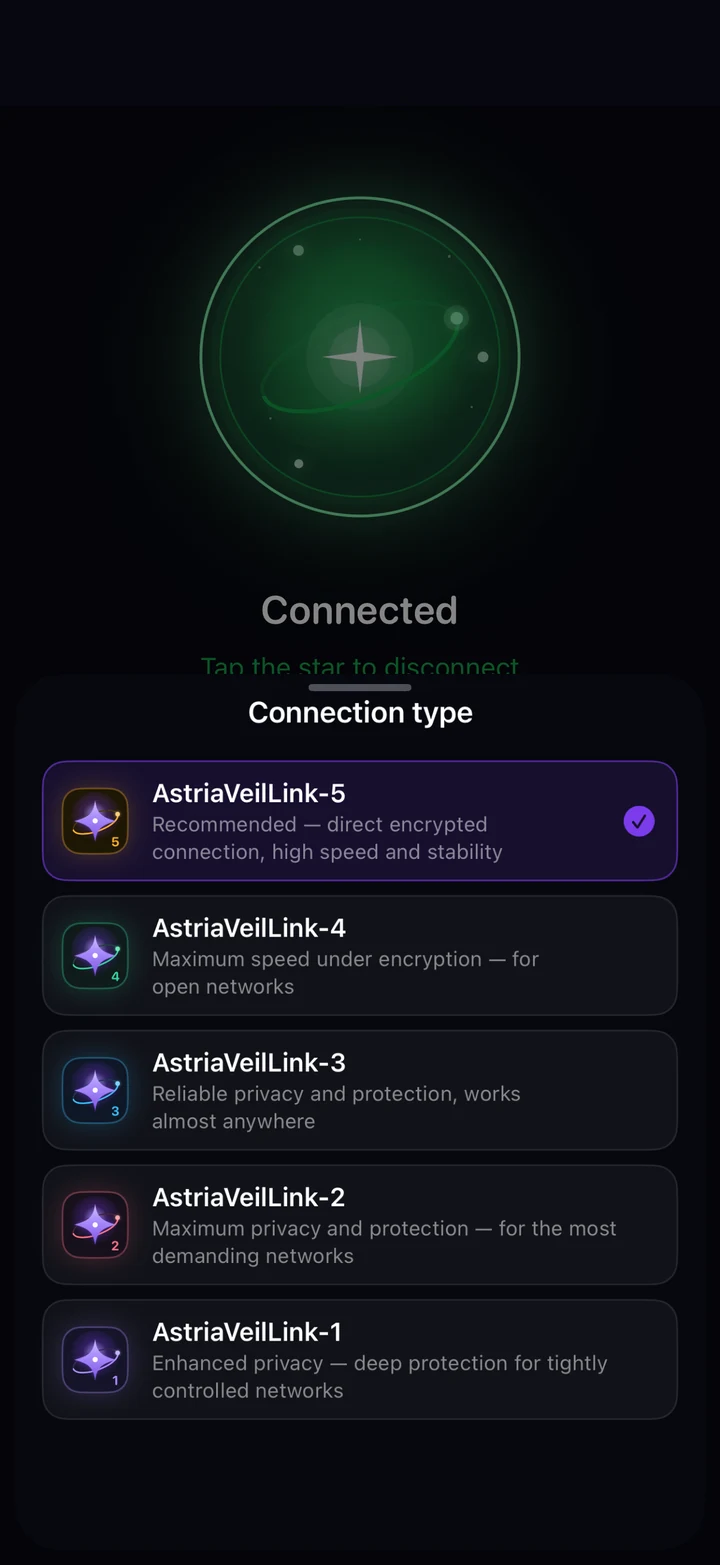
Tap “Connection type” to pick one of five AstriaVeilLink modes. We recommend AstriaVeilLink-5 for everyone: it is a direct encrypted connection with the highest speed and stability, and it is the default.
If a particular network gives you an unstable connection, step down one mode at a time — AstriaVeilLink-4, then -3, -2 and finally -1. Each step down trades a little speed for more reliability headroom. The choice applies the next time you connect.
- AstriaVeilLink-5 — direct encrypted connection, high speed and stability (recommended, start here).
- AstriaVeilLink-4 — maximum speed under encryption, for open networks.
- AstriaVeilLink-3 — reliable privacy and protection that works almost anywhere.
- AstriaVeilLink-2 — maximum privacy and protection for the most demanding networks.
- AstriaVeilLink-1 — enhanced privacy and the most cautious mode; the last step.
Step 6: Turn on the protection features
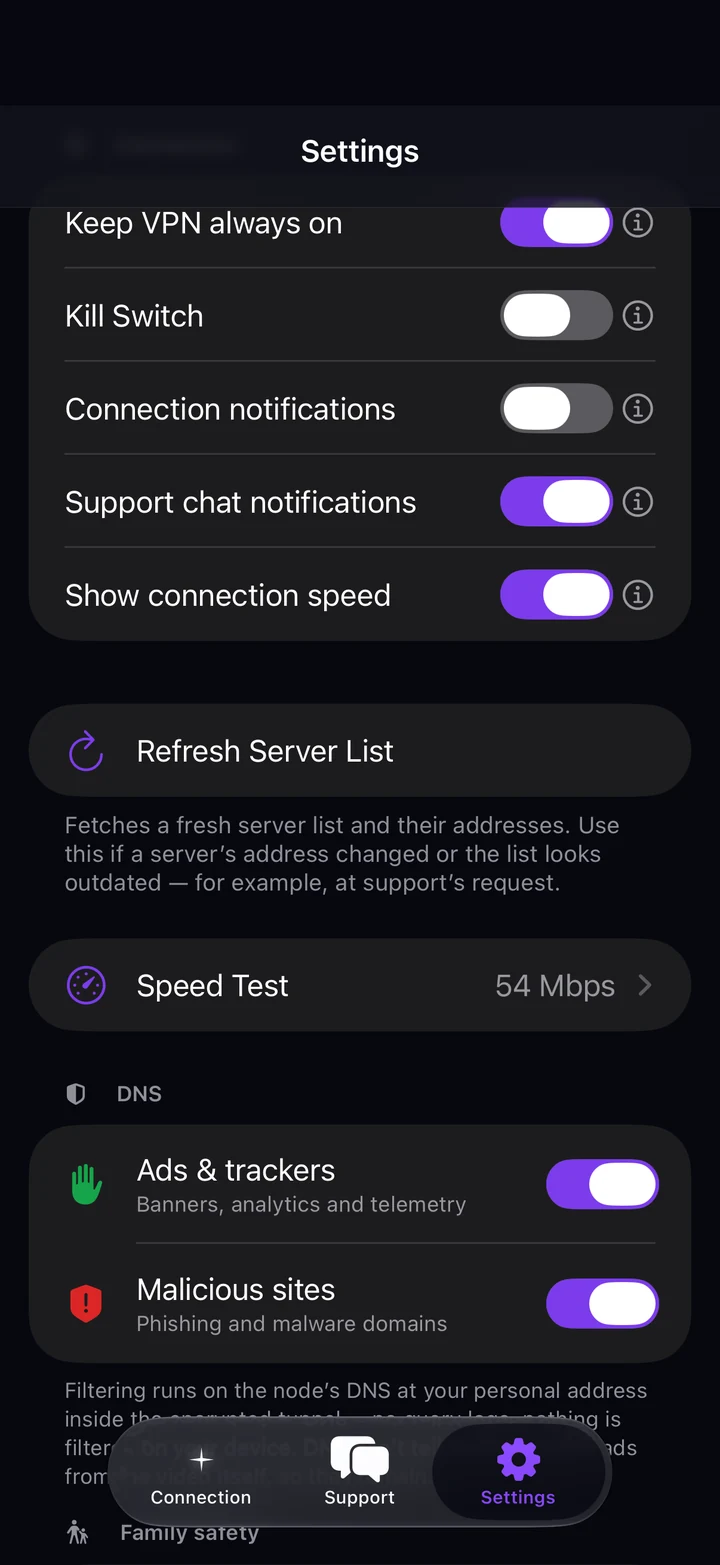
Open the Settings tab. The Connection section holds the switches that keep your data protected. Recommended setup: leave Kill Switch on, keep “Ads & trackers” and “Malicious sites” on in the DNS section, and keep the connection type on AstriaVeilLink-5.
- Keep VPN always on — iOS keeps the VPN running even when the app is closed. Turning it off switches the VPN off until you connect manually again.
- Kill Switch — blocks traffic from silently leaking out in the open if the tunnel drops or is switching while you intend to stay connected. Turning the VPN off manually restores normal internet at once.
- Connection notifications and Support chat notifications — optional alerts.
- Show connection speed — shows the timer, the live speed and your address inside the tunnel on the Connection screen.
- Refresh Server List — fetches a fresh list of servers and their addresses; use it if a server’s address changed or the list looks outdated.
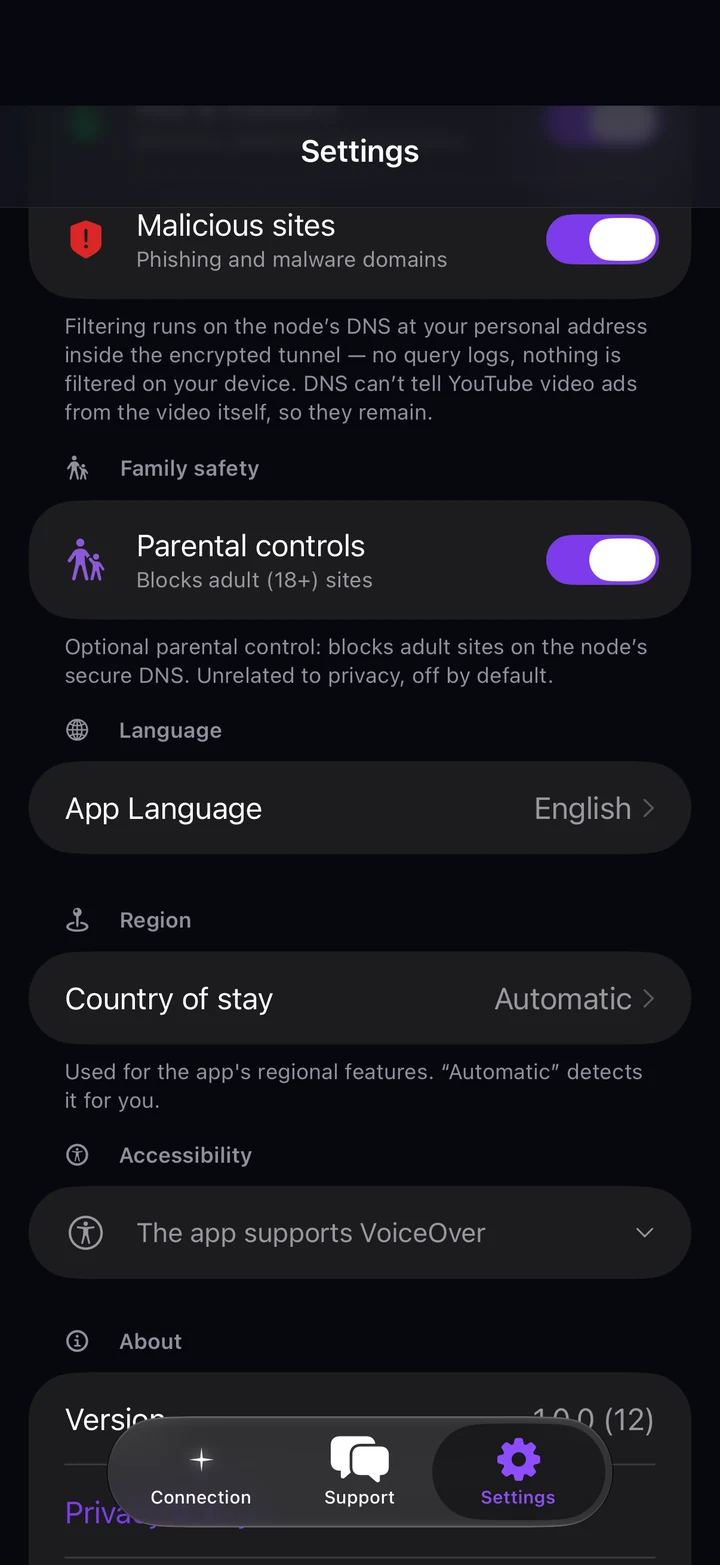
- DNS protection — your DNS queries are answered by Astria VPN’s own resolver on the VPN node, inside the encrypted tunnel, without third-party DNS providers. “Ads & trackers” blocks banners, analytics and telemetry; “Malicious sites” blocks phishing and malware domains. DNS filtering does not block YouTube video ads.
- Parental controls — an optional switch that blocks adult (18+) sites on the node’s secure DNS; it is unrelated to privacy and is off by default.
Step 7: Split tunneling
Split tunneling is a single switch on the main screen, below the location fields. It is off by default and never turns on by itself. When it is on, sites and services in your region go directly and everything else goes through the VPN; when it is off, all traffic goes through the VPN. Choosing individual apps or sites is not available yet — it is in development.
Astria VPN exists to protect your data wherever you are. We do not offer or market the app in countries with special conditions for internet use. If you are about to travel to such a country, you can take your protection with you: the app has convenient settings for trips, including split tunneling with a choice of your country of stay (Settings → Region → Country of stay; “Automatic” detects it by itself). Before you travel, read the local rules — following them remains your responsibility.
Step 8: Check the speed
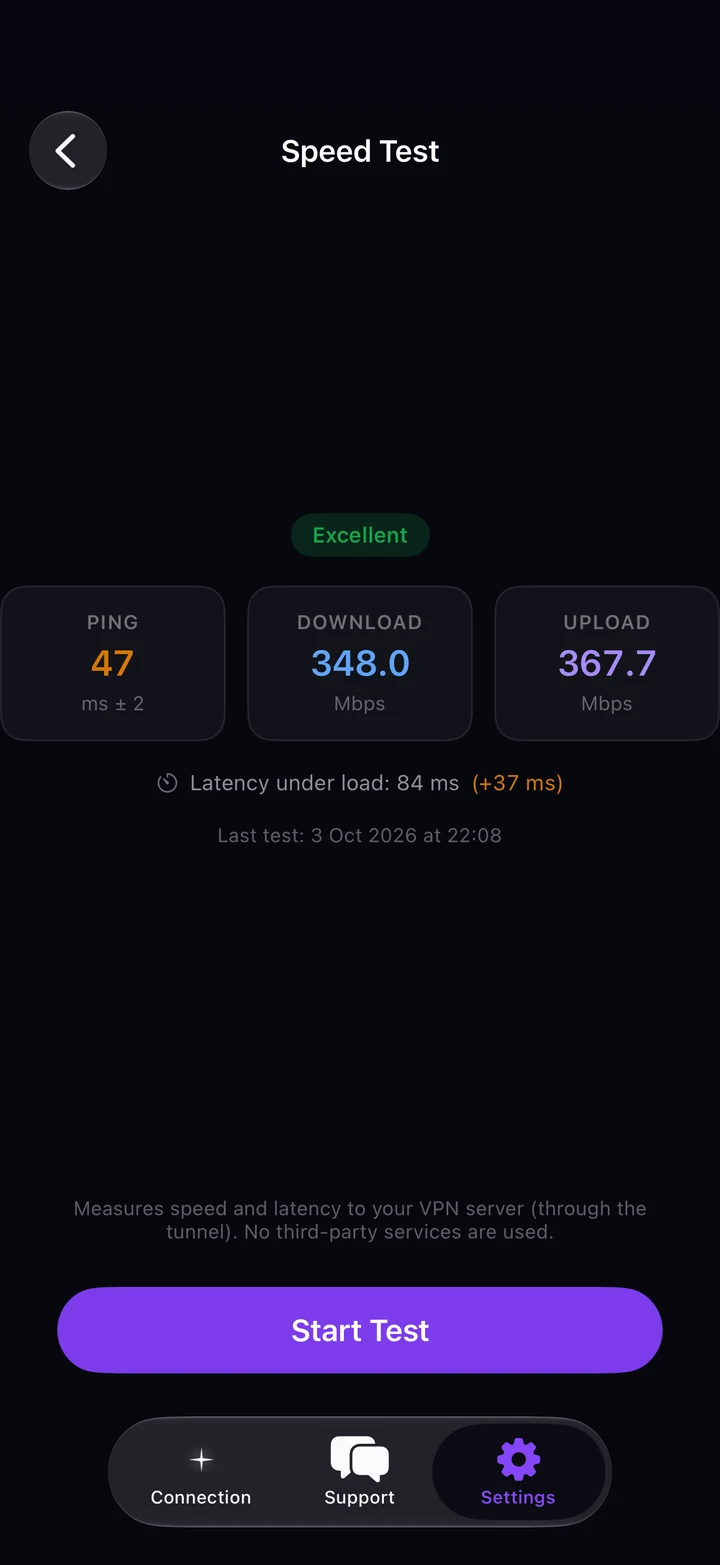
Settings → Speed Test measures your speed and response time to your Astria VPN server, through the tunnel. It works only while the VPN is on: when it is off, the screen asks you to turn the VPN on first.
Connect first, then open Speed Test and tap “Start Test”. The test uses your own VPN server, not an external website, so it shows the quality of your protected connection. The result shows ping, download and upload speed and the latency under load, with a short rating (for example “Good” or “Excellent”) and the time of the last test. Tap “Start Test” again to measure again.
Step 9: Account, devices and language
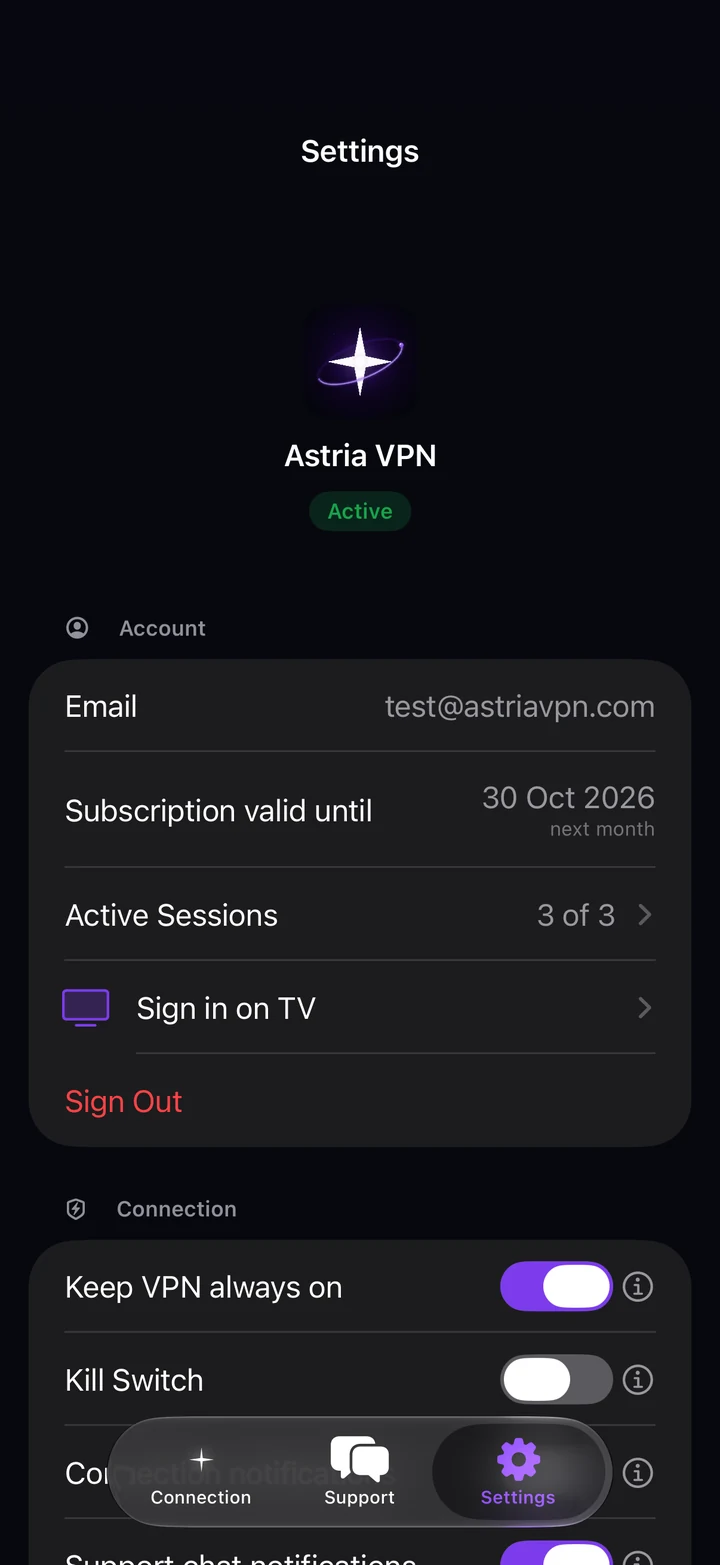
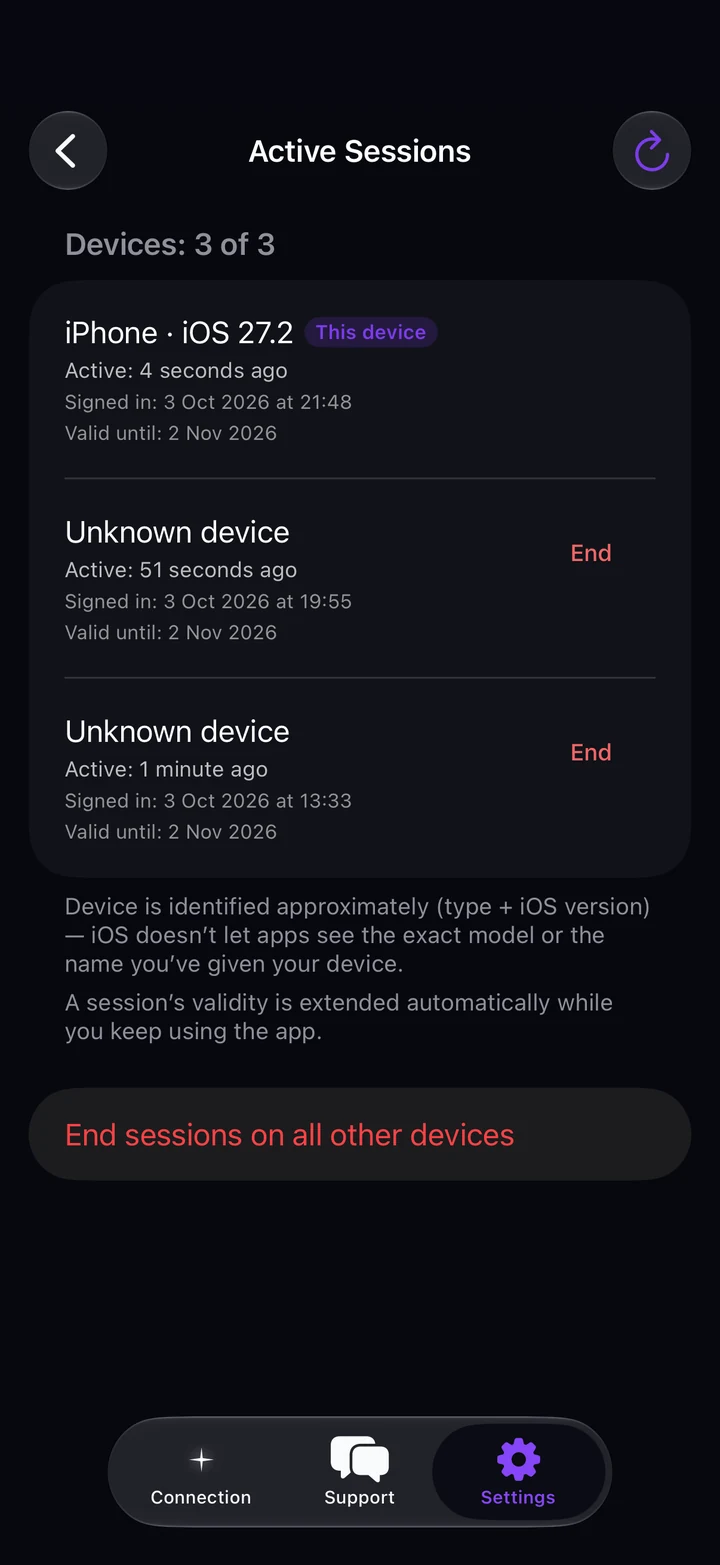
At the top of Settings you see your account: email, subscription end date and “Active Sessions” — how many of your allowed devices are signed in (for example “3 of 3”). Open it to see your devices, sign a single device out with “End”, or choose “End sessions on all other devices”; this device stays signed in. “Sign in on TV” links the Astria VPN app on your TV, and “Sign Out” signs this iPhone out of your account.
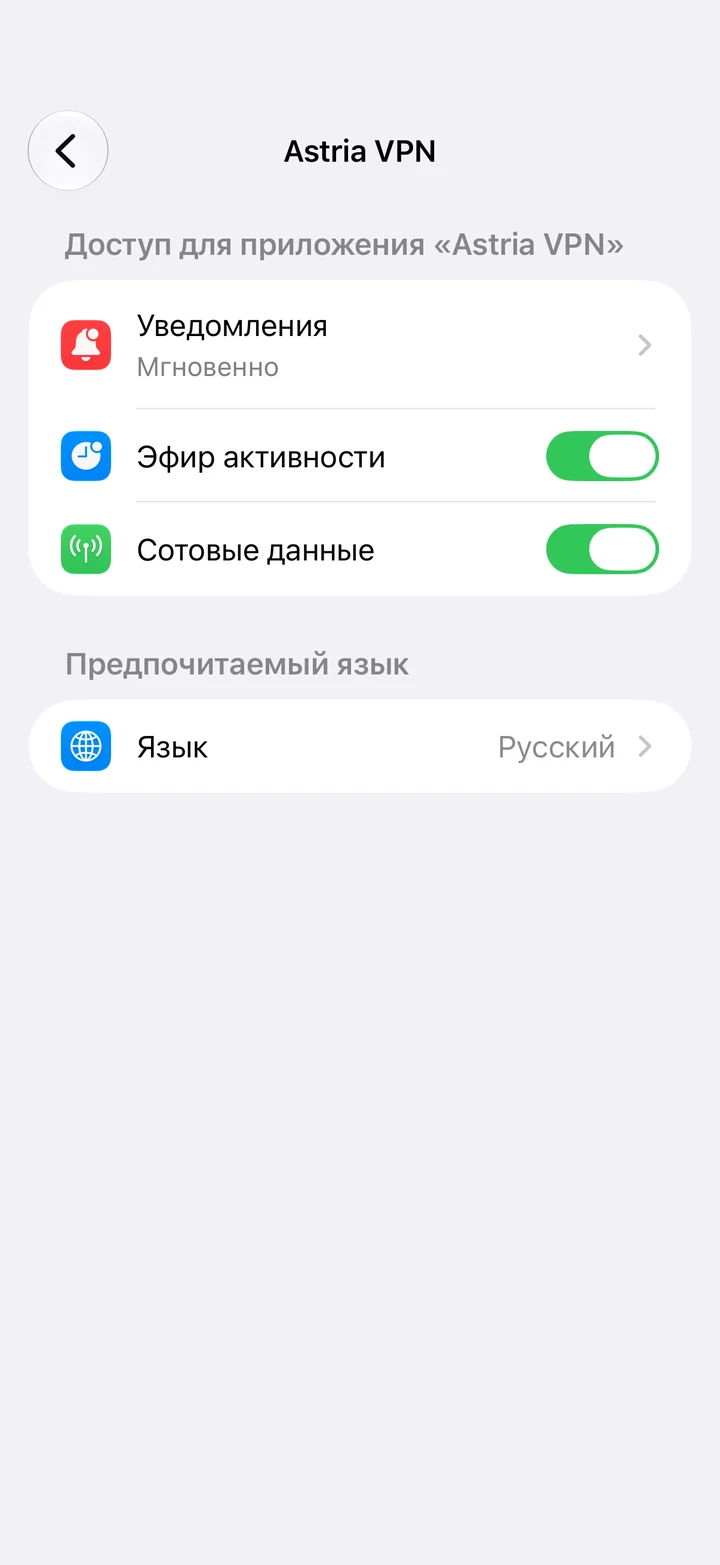
To change the app language, tap “App Language”: iOS opens its Settings page for Astria VPN, where you choose English, Russian, Ukrainian or Chinese; the app restarts in the chosen language. In the Region block, “Country of stay” stays on “Automatic” unless you want to set it yourself. “About” shows the version, the Privacy Policy and the Terms of Use.
Step 10: Contact support in the app
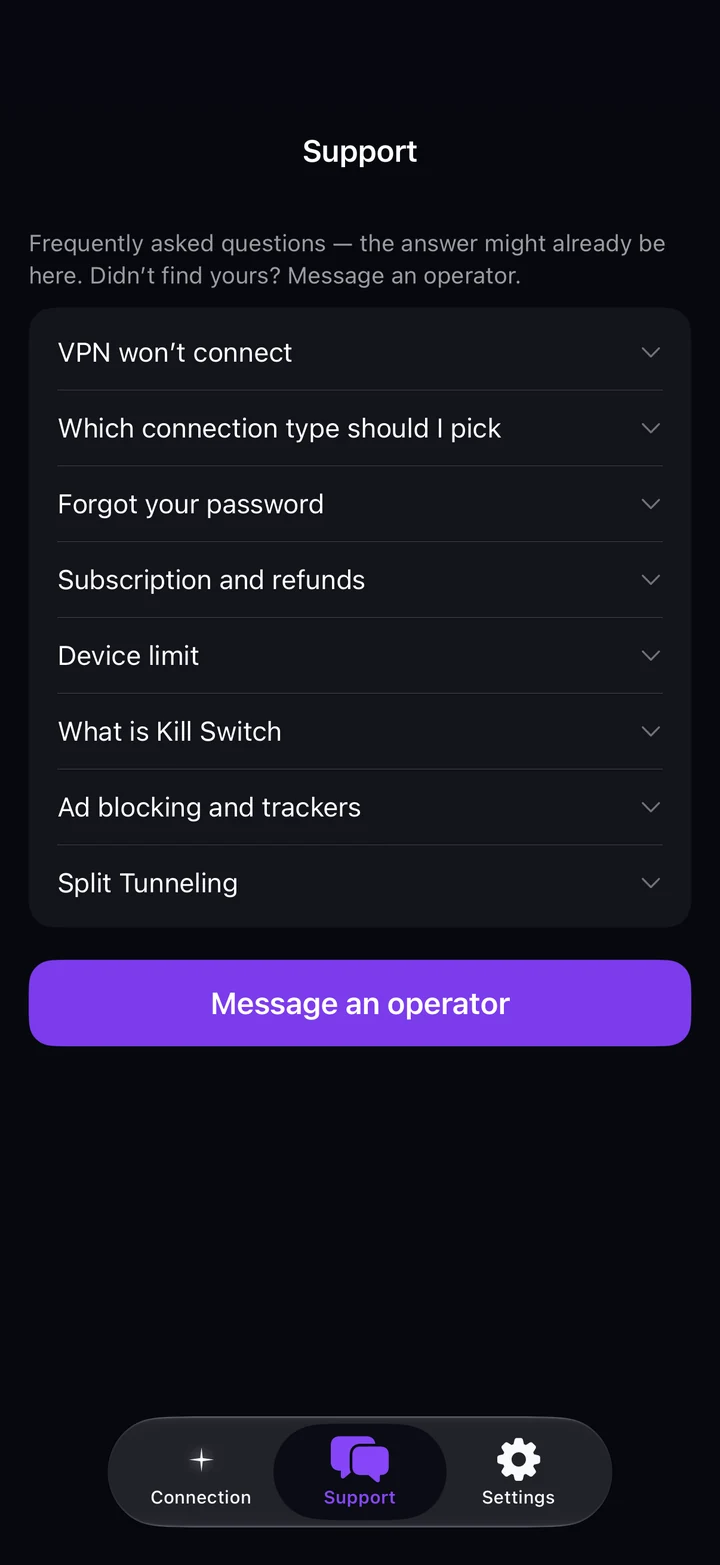
The Support tab shows short answers to frequent questions — VPN won’t connect, which connection type to pick, forgot password, subscription and refunds, device limit, Kill Switch, ad blocking and split tunneling. If your question is not there, tap “Message an operator” to open the chat with our team, or write to support@astriavpn.com.
Quick tips for the best protection
- Keep the connection type on AstriaVeilLink-5 and only change it if a network is unstable.
- Leave Kill Switch and DNS protection on at all times.
- Keep “Keep VPN always on” enabled so iOS restores the protection after the app is closed.
- Run the speed test only after you connect — it measures the path to your VPN server.
- Install TestFlight updates when they appear to stay on the latest build.
Frequently asked questions
Is the iPhone app in the App Store?
Not yet. The iOS app is a beta distributed through Apple’s TestFlight. It is free for current Astria VPN users and is issued on request by support; a subscription does not include the iOS app or its support.
How do I get access to the beta?
Ask support: use “Request access” on the download page (it opens our support chat) or write to support@astriavpn.com. You will get a TestFlight invitation link; open it on your iPhone with the TestFlight app installed.
Which connection type should I use on iPhone?
Use AstriaVeilLink-5. It is the recommended default — a direct encrypted connection with the highest speed and stability. Switch to -4, -3, -2 and -1 only if a network makes the connection unstable.
How do I connect and disconnect?
Open the Connection tab and tap the Astria star. It turns green when you are connected. Tap it again to disconnect.
What does Kill Switch do?
It stops traffic from silently leaking out in the open if the tunnel drops or is switching while you intend to stay connected. Turning the VPN off manually restores normal internet right away.
What does “Keep VPN always on” do?
When it is on, iOS keeps the VPN running even when the app is closed. Turning it off switches the VPN off until you connect manually again.
Why is the Speed Test not starting?
The test measures your connection to your VPN server, so it works only while the VPN is connected. Connect first, then open Settings → Speed Test.
How many devices can I use?
The number depends on your plan (1, 3 or 5 devices). Settings → Active Sessions shows how many are in use and lets you sign a device out.
Does Astria VPN block ads?
Yes — ad and tracker blocking works at the DNS level on the VPN node. YouTube video ads cannot be told apart from the video by DNS, so they remain.
What if I forgot my password?
Tap “Forgot password?” on the sign-in screen (beta build 13 and newer), or open billing.astriavpn.com yourself and choose “Forgot password?”: enter your email and follow the link in the email we send you. The password is recovered on the website, not inside the app. If the email does not arrive, check your Spam folder and write to support@astriavpn.com.
Where do I get help?
Open the Support tab for answers to common questions and the chat with an operator, or write to support@astriavpn.com.
Get the app
Request access to the iOS beta from support, or start with the free 24-hour trial in Telegram.